
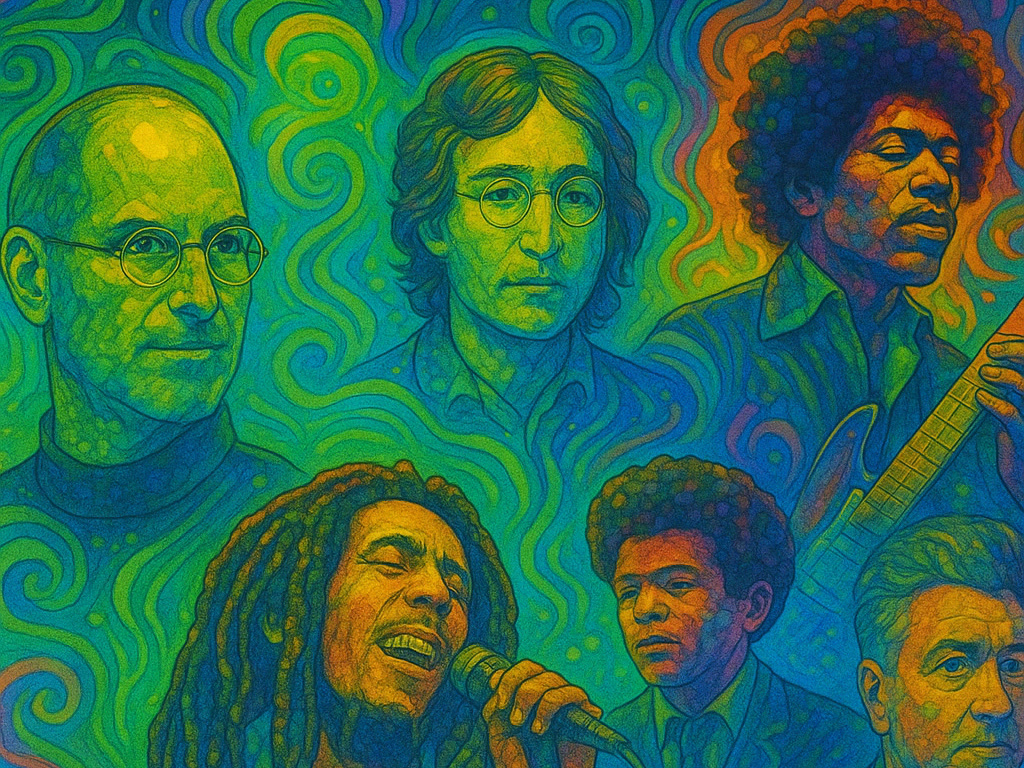
Visionary creators throughout history have explored altered states of consciousness to fuel their artistic endeavors, gain spiritual insight, and catalyze personal transformation.
From writers and musicians to scientists and philosophers, many have utilized substances like psychedelics and cannabis, or practices such as meditation and sensory deprivation, as tools for inspiration and self-discovery.
-
Aldous Huxley – The Brave New World author used mescaline and LSD to "unlock the 'reducing valve' of the brain," which inspired his influential book The Doors of Perception.
-
Charles Baudelaire – A member of Paris's "Club des Hashischins," this French poet used hashish and opium as creative catalysts for his work on "artificial paradises."
-
Arthur Rimbaud – The young Symbolist poet deliberately embraced absinthe and hashish to achieve a "reasoned deranging of all the senses," which fueled his revolutionary, visionary poetry.
-
Ken Kesey – Kesey volunteered for government studies on LSD and other psychoactive drugs, using the experience to write One Flew Over the Cuckoo's Nest and later hosting "Acid Test" parties to challenge conformity.
-
Allen Ginsberg – A Beat poet who used peyote and marijuana while writing Howl, and later advocated for psychedelics after participating in Harvard's Psilocybin Project.
-
Michael Pollan – As a journalist, he undertook guided LSD, psilocybin, and 5-MeO-DMT sessions in his 60s for How to Change Your Mind, calling the experience a "brain reboot."
-
Isabel Allende – Participated in an ayahuasca ceremony to grieve her daughter, which she called an "amazingly vivid and visual spiritual trip" that was "absolutely healing."
-
The Beatles – Their mid-60s creative leap, especially John Lennon's songwriting, was sparked by LSD and reflected in albums like Revolver and Sgt. Pepper.
-
Jimi Hendrix – Used LSD in small doses to break creative boundaries and revolutionize psychedelic guitar music.
-
Jim Morrison – Frontman of The Doors, used LSD and peyote to channel mystical insights and create dream-like lyrics.
-
Bob Marley – As a Rastafarian, Marley viewed cannabis as a sacrament that revealed truth and connected him to divine energy.
-
Grace Slick – Wrote "White Rabbit" after an acid trip, crafting the song to musically replicate an LSD experience.
-
Brian Wilson – Credited an LSD-induced "spiritual awakening" with inspiring Pet Sounds and expanding his musical vision.
-
Willie Nelson – Said cannabis saved him from depression and helped him remain relaxed and creative throughout his life.
-
Kesha – Turned to ayahuasca and spirituality to process trauma and fuel her recent introspective music.
-
Sting – Described ayahuasca as "the only genuine religious experience" he has ever had.
-
Susan Sarandon – Has used ayahuasca and psilocybin to explore consciousness and gain new perspectives.
-
Dr. Kary Mullis – Nobel-winning chemist who credited LSD with helping him conceptualize PCR, calling it more useful than any academic course.
-
Dr. Francis Crick – Co-discoverer of DNA’s structure, who reportedly used small LSD doses to help visualize the double helix.
-
Carl Sagan – Under pseudonym "Mr. X," praised cannabis for enhancing perception and sparking scientific ideas.
-
Richard Feynman – Used isolation tanks, hypnosis, and possibly ketamine to induce hallucinations and explore consciousness.
-
Steve Jobs – Called LSD "one of the most important things" in his life, crediting it with shaping his creative vision at Apple.
-
Thomas Edison – Used hypnagogic micro-naps to harvest ideas from the threshold between waking and sleep.
-
Siddhartha Gautama (The Buddha) – Achieved enlightenment through deep meditation under the Bodhi Tree, a self-induced altered state.
-
Rumi – Practiced whirling dance to reach ecstatic union with the divine, resulting in some of the world’s most transcendent poetry.
-
Ram Dass – Former Harvard professor turned spiritual teacher, who saw psychedelics as an "appetizer" to deeper meditative practice.
-
Alan Watts – Used LSD and mescaline to explore Zen enlightenment, but advised "once you get the message, hang up the telephone."
-
Terence McKenna – Psychedelic philosopher who viewed substances like psilocybin as portals to mystical experience and human evolution.
-
Aleister Crowley – Occultist who used hashish and mescaline in magick rituals to explore the astral realm.
-
Carl Jung – Induced visionary states through "Active Imagination," meeting archetypal figures that shaped analytical psychology.
-
María Sabina – Mazatec shaman whose sacred mushroom ceremonies introduced psilocybin to the West and inspired modern psychedelic practice.
-
Jack Kerouac – Beat writer who used benzedrine and cannabis to fuel his spontaneous prose, especially in On the Road.
-
Jack Nicholson – Described LSD in the 1960s as a “revelatory” experience that deepened his self-understanding.