
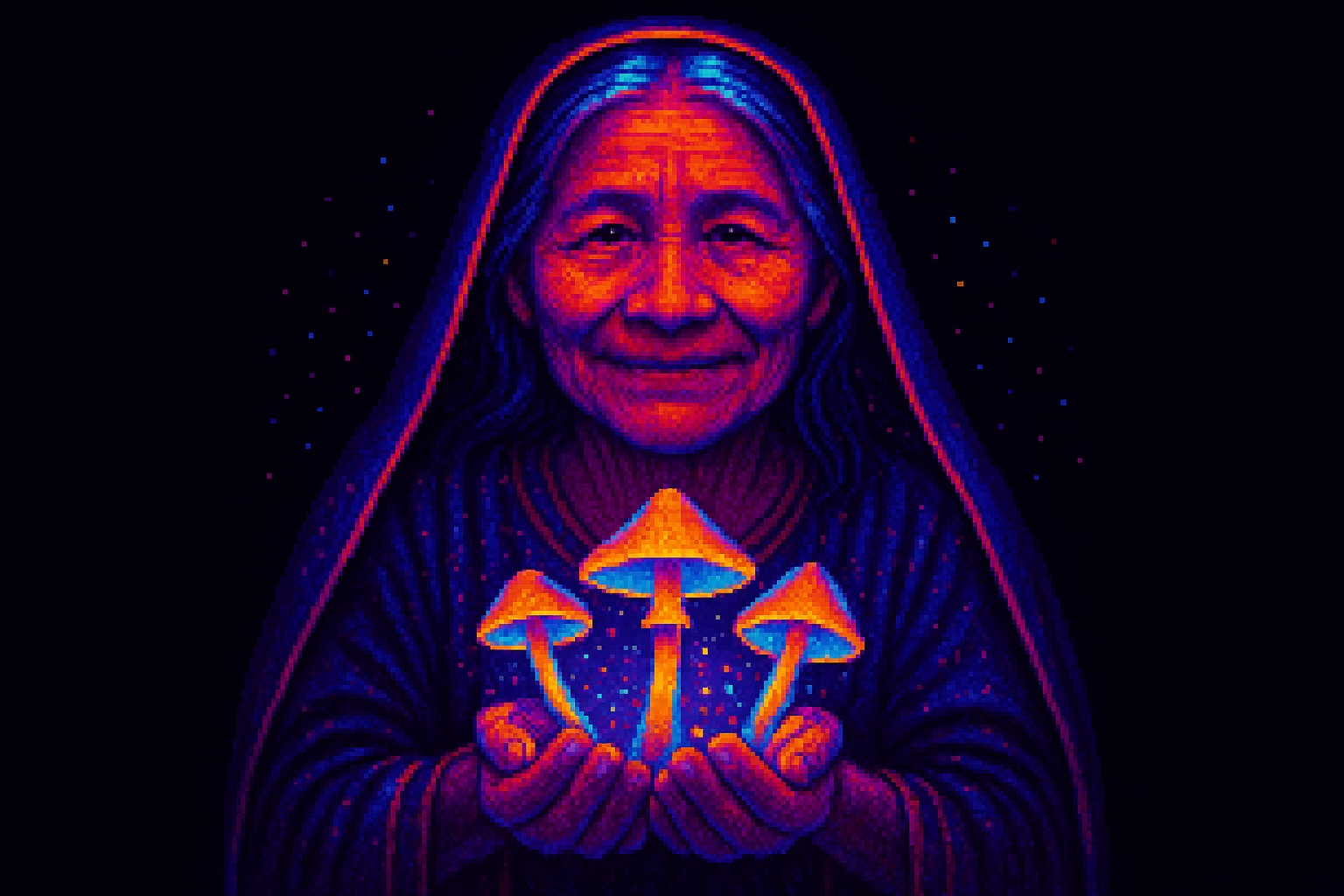
Before Timothy Leary, there were women reshaping the psychedelic frontier.
The popular telling of psychedelic history focuses on a handful of male icons. But the movement’s DNA was knit together in large part by women—Indigenous healers, medical researchers, underground therapists, avant-garde writers—whose insights continue to shape today’s clinical protocols and cultural conversations.
Their stories offer a parallel timeline: from mountain temples in Oaxaca to Los Angeles living rooms, from hospice wards to fugitive road trips. Recovering these voices does more than set the record straight; it widens the imaginative horizon of what altered states can do for healing, creativity, and community.
Roots and Rituals
María Sabina – The Mushroom Priestess
In the highlands of Huautla de Jiménez, Mazatec curandera María Sabina led all-night veladas with psilocybin mushrooms she called los niños santos—“the holy children.” Her chants, performed in total darkness, transformed the experience into a sacred dialogue with the spirit world.
In 1955, she allowed R. Gordon and Valentina Wasson to join a ceremony. That moment quietly launched the West’s mushroom movement. But it also invited floods of seekers, many disrespecting the rituals they claimed to admire. Sabina would later say the mushrooms had lost their purity.
She never sought fame or credit. Yet today, every Western psilocybin journey, therapeutic or otherwise, walks through the door she opened.
Valentina Wasson – The Medical Bridge
Valentina Wasson, a Russian-American pediatrician, saw more than mysticism in Sabina’s ceremony. She returned convinced psilocybin could help with alcoholism, trauma, and end-of-life anxiety.
It was Valentina—not Gordon—who first suggested studying mushrooms, first reached out to Albert Hofmann with samples, and first wrote about their therapeutic promise in the U.S. popular press. Her 1957 essay, “I Ate the Sacred Mushrooms,” introduced millions of readers to the idea that Indigenous ritual had modern medical potential.
She lobbied Sandoz Pharmaceuticals to produce a pure psilocybin capsule, laying early groundwork for today’s clinical trials. Her vision, of psychedelics as healing medicine rooted in respect for cultural origin, was decades ahead of her time.
Betty Eisner – Set, Setting, and the Social Matrix
A psychologist in 1950s California, Betty Eisner worked on some of the first LSD therapy sessions in the U.S. She’s credited with coining or popularizing “set and setting,” but added a third concept often overlooked: matrix.
The matrix described a person’s broader social context—their support systems, relationships, and daily life—which she believed critically shaped integration after a trip. Today, as therapists emphasize long-term aftercare and community, her ideas feel not just modern, but essential.
She also pioneered techniques still in use today: music during sessions, low-dose “psycholytic” therapy, and co-therapist pairs to create safety. Most histories credit her male collaborators. But the actual architecture of psychedelic therapy? That was Betty.
Experimental Salons and Literary Frontiers
Anaïs Nin – The Inner Space Cartographer
In 1955, novelist Anaïs Nin took LSD as part of an early psychiatric research program. But what she brought back wasn’t data, it was art. She described textures rippling, colors singing, and her body as “liquefied light.” The experience was sensual, emotional, and deeply embodied.
She later critiqued the “false transcendence” of many male-led sessions, arguing that real transformation demanded emotional labor and narrative integration. Her journals helped seed a feminine model of tripping—where insight came not from escape, but from deeper self-expression.
Today, when users write about their psychedelic journeys in apps like ALTERD, they’re walking a path Nin helped pioneer.
Nina Graboi – The First Public Educator
A Holocaust survivor turned consciousness activist, Nina Graboi co-founded the League for Spiritual Discovery’s New York center with Timothy Leary. It became the first open LSD meditation space in Manhattan.
Years before “harm reduction” was a movement, she was giving free public talks on safe tripping, spiritual grounding, and how to integrate altered states into ordinary life. She helped bring psychedelics from backroom salons into public consciousness, while maintaining a focus on ethics and care.
Laura Archera Huxley – Death’s Gentle Guide
On the morning of November 22, 1963, writer Aldous Huxley lay dying of cancer. His final request: LSD. Laura prepared and administered 100 micrograms. She sat with him as he passed, describing it later as “a most beautiful death.”
But her impact didn’t end there. A trained therapist and author, Laura wrote and lectured for years on emotion, care, and consciousness. She was one of the first to propose psychedelics as tools for dying with dignity, an idea echoed today in psilocybin hospice trials.
Rebellion, Recovery, and the Underground Years
Rosemary Woodruff Leary – The Architect of Escape
Wife and collaborator of Timothy Leary, Rosemary Woodruff Leary was more than a muse. She helped transform the Millbrook estate into a multisensory psychedelic sanctuary—full of tapestries, lights, music, and carefully curated sessions.
When Timothy was jailed in 1970, she engineered his dramatic prison escape, then spent years as a fugitive abroad. Her life blurred the line between resistance, ritual, and logistics. For her, psychedelia wasn’t just about inner space, it was about altering the world, too.
Ann Shulgin – The Queen of Integration
Ann Shulgin was a lay therapist who guided clients through MDMA and 2C-B sessions before these substances were criminalized. Her approach was rooted in Jungian psychology and “shadow work,” helping people confront the repressed, wounded parts of themselves to spark deep healing.
With her husband Sasha, she co-authored PiHKAL and TiHKAL, detailing psychedelic compounds, effects, and safe usage. But more importantly, she insisted that psychedelics weren’t shortcuts to bliss—they were tools for real inner transformation.
Her voice continues to shape how therapists approach trauma, narrative, and aftercare.
Joan Halifax – LSD Meets Zen
In the late 60s, Joan Halifax co-led LSD-assisted therapy for terminally ill patients at Spring Grove Hospital. She watched firsthand as people with cancer confronted, and eased, the fear of death through guided psychedelic sessions.
Later, as a Zen teacher, she merged that experience with Buddhist end-of-life care. Her “Being with Dying” retreats became a model for integrating spiritual practice and psychedelic insight into hospice work.
She helped normalize the idea that altered states could serve not just healing, but dying well, and brought compassion to the frontier of psychedelic science.
Carrying the Torch Forward
Platforms like ALTERD, building upon this knowledge, have an opportunity to acknowledge the profound contributions of figures like María Sabina with her deep understanding of ritual, Valentina Wasson with her early medical insights, Betty Eisner with her emphasis on environment, and Ann Shulgin with her focus on inner exploration.
By integrating these narratives, we gain a richer understanding of the psychedelic field – one where healing involves connection, creativity flourishes in shared spaces, and the journey forward has always involved diverse voices.
Sources
- The Earthly Journeys of María Sabina – Fungi Foundation
- Set, Setting, and Matrix – Betty Eisner (PubMed)
- Betty Eisner and Matrix in LSD Therapy – PubMed Central
- Anaïs Nin Describes Her LSD Trip – Nancy Tinari
- Valentina Wasson’s Role in Psychedelic Medicine – Journal of Psychedelic Studies
- The Nice Married Couple Who Inspired People to Shroom – JSTOR Daily