
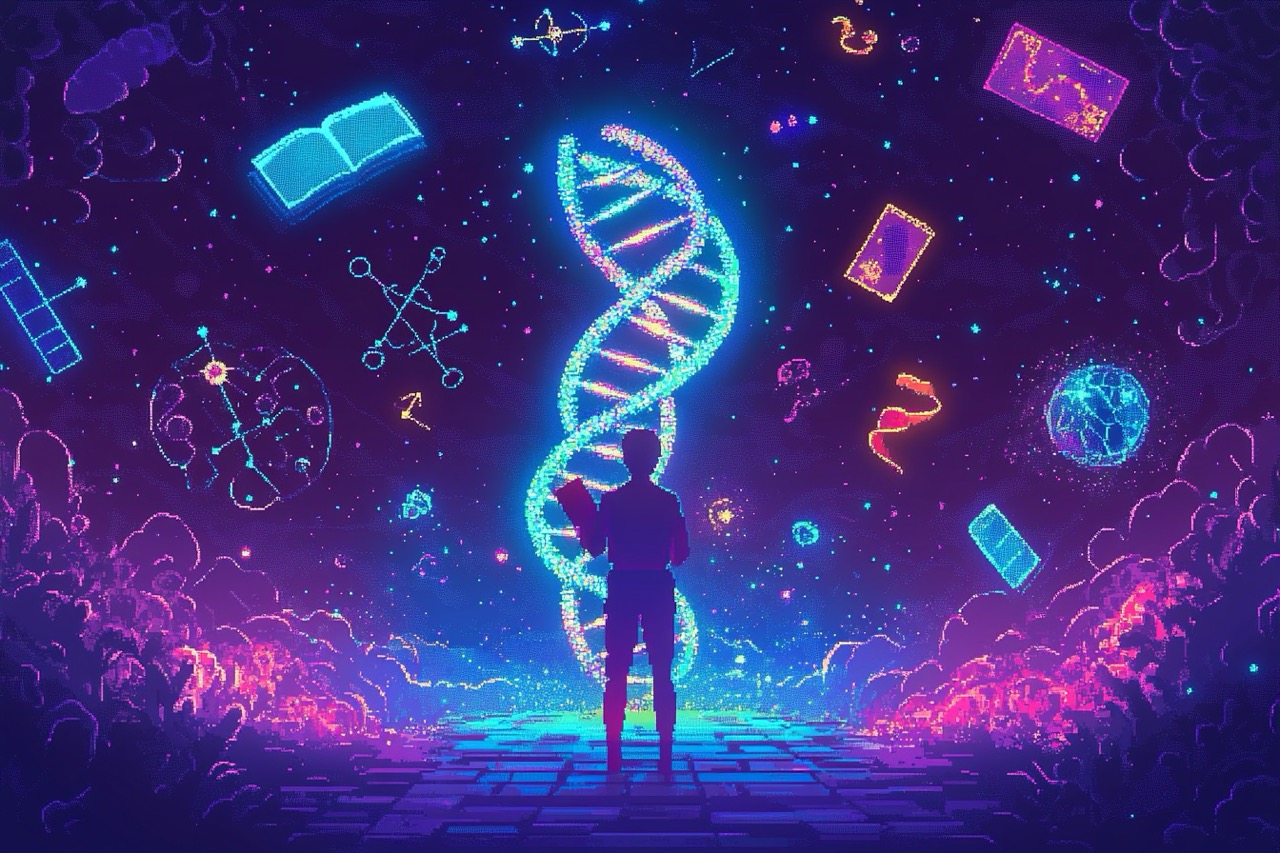
Kary Mullis’s LSD-Fueled Nobel Discovery
PCR: A Revolution in Genetic Science
Polymerase Chain Reaction (PCR) is a cornerstone of modern biology – a technique that lets scientists amplify tiny samples of DNA into abundant quantities within hours. Its impact is difficult to overstate. From medical diagnostics and COVID-19 tests to forensic DNA fingerprinting and genomic research, PCR underpins countless innovations. The invention of PCR in 1983 is often described as a watershed moment – “virtually dividing biology into the two epochs of before PCR and after PCR.” For devising PCR, a then-obscure biochemist named Kary B. Mullis went on to share the 1993 Nobel Prize in Chemistry. But the origin story of this revolutionary technique is as astonishing as the invention’s impact. According to Mullis himself, his breakthrough emerged from an unlikely source: a late-night drive in California under the lingering glow of LSD.
A Flash of Genius on a Late-Night Drive
In the spring of 1983, Mullis was working at a California biotech company (Cetus Corporation) synthesizing DNA fragments. One Friday night, he set off on a long drive through Mendocino County. As the miles rolled by, Mullis’s mind wandered back to a nagging scientific puzzle: how to reliably make lots of a specific DNA segment in a test tube.
Suddenly, inspiration struck. He realized he could use two short DNA primers and cycle them through rounds of copying, doubling the DNA each time. He pulled the car over, grabbed a notebook, and sketched out what would become the basic mechanism of PCR. Back at work, Mullis’s idea initially met skepticism. But with refinements—like the introduction of a heat-resistant enzyme—PCR evolved into one of the most important tools in molecular biology.
It wasn’t just the idea that made PCR transformative—it was its exponential power. With every cycle, DNA doesn’t just increase linearly, it multiplies. Within 30 cycles, a single DNA segment can generate over a billion copies. That exponential amplification revolutionized genetics, making previously impossible analyses routine. What once took weeks in a lab could now be done in hours.
LSD and Molecular Vision
What led Mullis to see the solution so clearly? He partially credited LSD. During his student years at Berkeley, Mullis regularly experimented with psychedelics and described them as deeply “mind-opening.” He believed LSD helped him visualize molecular processes in his mind’s eye, allowing him to understand DNA in motion.
“What if I had not taken LSD ever; would I have still invented PCR? I don’t know. I doubt it. I seriously doubt it.”
That quote, repeated across interviews and lectures, captured his conviction that psychedelics fundamentally shaped his way of thinking. Mullis claimed LSD helped him “ride along a molecule of DNA” and witness replication firsthand. He wasn’t alone—Francis Crick and others have also credited psychedelics with insights into complex systems. Whether or not LSD directly caused the discovery, Mullis believed his altered state experiences made him more creative, visual, and intuitive than traditional training alone could.
He also claimed that while under the influence, he could “see electrons moving” and experience chemistry not just as formulas, but as a flowing system. That kind of immersive imagination is hard to teach—and may be part of what set him apart. Mullis believed that LSD allowed access to mental dimensions where traditional problem-solving gave way to sudden, holistic understanding.
Meeting the Father of LSD
In 2006, Mullis met Albert Hofmann, the chemist who first synthesized LSD, at a conference celebrating Hofmann’s 100th birthday. Mullis told Hofmann directly that his psychedelic experiences helped him invent PCR. For Hofmann, who had long championed the creative potential of LSD, it was a moment of poetic full-circle recognition.
The Basel symposium where they met brought together scientists, artists, and psychologists from around the world to honor the influence of psychedelics on creativity. Mullis, as a Nobel Prize-winning speaker, stood out—not just for his accomplishments, but for his open embrace of altered states. Hofmann later shared publicly that Mullis’s story affirmed what he had always suspected: that LSD could genuinely unlock creative genius.
A Maverick Mindset
Mullis’s LSD use was just one expression of his nonconformity. He surfed, dabbled in astrology, and held controversial views that alienated much of the scientific community—like denying climate change and HIV’s link to AIDS. But his irreverence and outsider status may have been what allowed him to challenge assumptions in the first place.
Mullis’s colleagues described him as brilliant, combative, and unfiltered. Some argued he oversimplified PCR or hogged credit. Others believed only someone with his intuitive, nonlinear mind could’ve pulled off such a conceptual leap.
He also recounted strange experiences that blurred the line between altered state and the mystical. In his autobiography Dancing Naked in the Mind Field, Mullis describes an incident involving a glowing raccoon who spoke to him—a moment he never fully explained, but never disavowed either. These anecdotes weren’t publicity stunts; they were glimpses into a mind unafraid of what others might label as irrational.
Altered States and ALTERD
Kary Mullis’s story is more than scientific folklore—it’s a compelling example of how altered states of consciousness can spark real-world breakthroughs. Whether or not LSD gave him the entire vision of PCR, it clearly helped unlock new mental perspectives. This is exactly the kind of transformation ALTERD is built to support. Our platform encourages people to explore altered states—whether through meditation, cannabis, breathwork, or psychedelics—and reflect meaningfully through journaling.
Mullis’s experience shows that when the mind is freed from default patterns, unexpected insights can arise. He used a notepad. With ALTERD, users can go deeper—logging experiences, reflecting with AI, and sharing insights with a like-minded community. We believe altered states are not escapes from reality, but tools for expanding it. Like Mullis on his night drive, you never know when an idea will hit—but when it does, we want to help you catch it, grow it, and integrate it.
Final Reflection
Kary Mullis was wild, brilliant, flawed, and unafraid to think differently. He showed that creativity doesn’t always come from the lab bench—it can arrive on a highway at night, riding shotgun with intuition and a head full of ideas. His legacy invites us to embrace altered thinking not as an escape, but as a portal—to innovation, to insight, and sometimes, to something revolutionary.
His tale reminds us that altered states—when approached with curiosity and respect—can deepen perception, break creative blocks, and help us see the invisible threads connecting ideas. Mullis’s PCR insight didn’t come from a chalkboard. It came from an altered lens on reality, followed by bold execution. That balance of imagination and rigor is what ALTERD champions.
So whether you’re journaling after breathwork, analyzing a mushroom trip, or just reflecting post-run, remember: insights live everywhere—and the next breakthrough might already be inside you, waiting for the right state of mind to be seen.