
-
Swiss chemist Albert Hofmann first created LSD in 1938 from a fungus that grows on rye. He accidentally experienced the world's first acid trip in 1943 after absorbing a small amount.
-
The name "LSD-25" was simply the lab's internal code for the substance, as it was the 25th compound in a series of lysergic acid derivatives created by Hofmann.
-
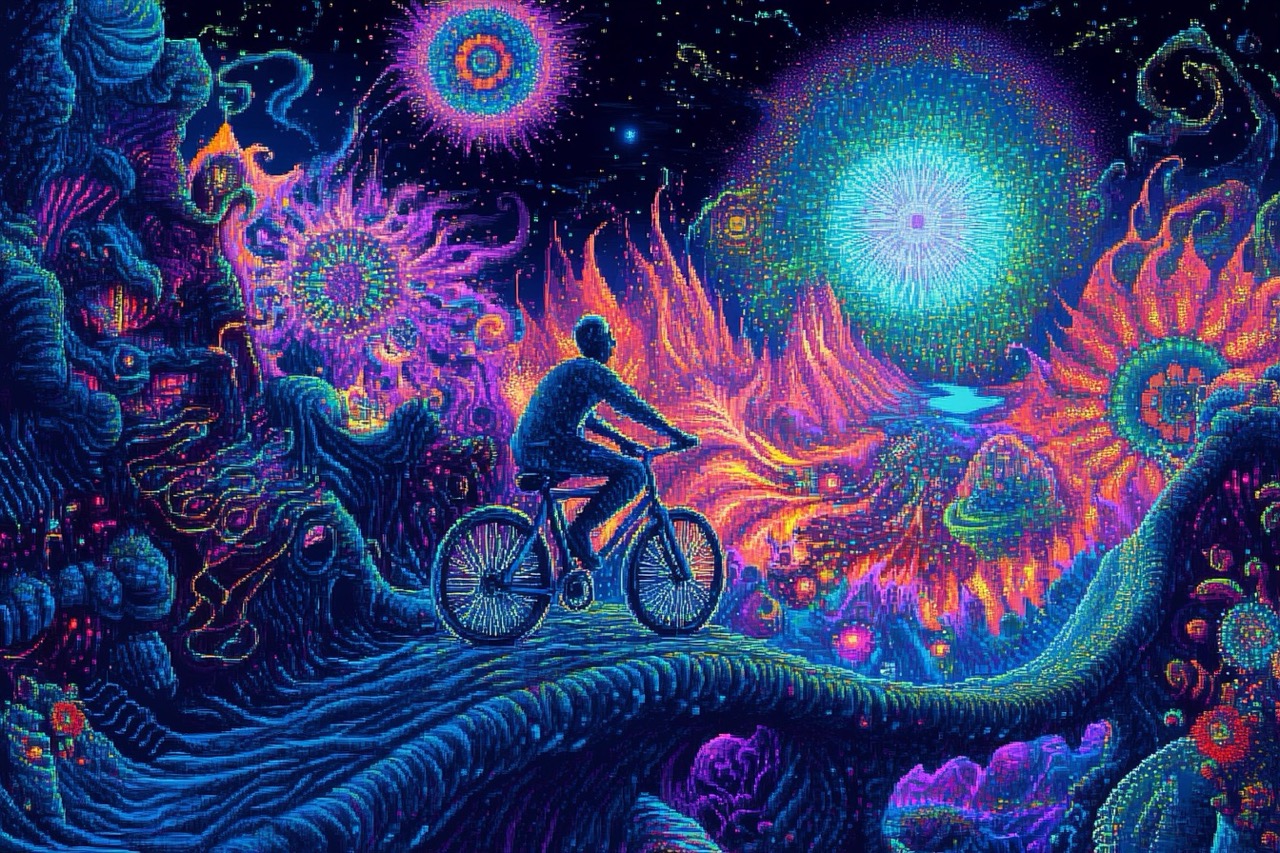
"Bicycle Day" is celebrated on April 19th to commemorate the first intentional LSD trip, when inventor Albert Hofmann took the drug in 1943 and rode his bicycle home while experiencing its intense, colorful effects.
-
LSD is one of the most powerful psychoactive substances known, with a typical dose being just 50-150 micrograms.
-
Because it's potent, colorless, and tasteless, LSD is commonly sold on small squares of absorbent paper that dissolve on the tongue. In the 1960s, it was also frequently dropped onto sugar cubes.
-
LSD primarily affects the brain's serotonin receptors, causing neural circuits to fire in unusual ways that alter perception, mood, and thought.
-
An LSD trip often involves sensory distortions like intensified colors and moving patterns. It can also cause synesthesia (like "seeing" sounds) and a feeling that time is stretching or looping.
-
An LSD trip is a long-lasting experience, with effects typically beginning within 20-90 minutes and lasting for 8 to 12 hours.
-
The LSD experience is highly unpredictable; it can be euphoric and enlightening (a "good trip") or nightmarish and terrifying (a "bad trip"), depending on the person's mindset and environment.
-
High doses of LSD can lead to "ego dissolution," a sensation where one's sense of self dissolves and merges with the universe.
This feeling is linked to brain networks that are normally separate starting to communicate with each other. -
Some users may experience "flashbacks"—brief, sudden recurrences of the trip's visual distortions—weeks or even years later. In severe cases, this is known as Hallucinogen Persisting Perception Disorder (HPPD).
-
While LSD is not toxic to the body's organs and there are no documented deaths from a direct overdose, it can cause impaired judgment that leads to fatal accidents.
-
The body develops a rapid tolerance to LSD, meaning it stops working if you take it multiple days in a row. The drug is not considered physically addictive and does not cause withdrawal symptoms.
-
Beginning in 1947, the pharmaceutical company Sandoz provided LSD to researchers under the brand name "Delysid" for use in psychotherapy.
-
Through the 1950s and early 1960s, LSD-assisted therapy showed promise for treating conditions like alcoholism, depression, and anxiety in some patients. An estimated 40,000 patients received this form of psychotherapy.
-
Hollywood star Cary Grant was a major advocate for LSD therapy in the late 1950s, participating in about 100 sessions to address his personal traumas. He credited the experience with "saving" him.
-
During the Cold War, the CIA's secret Project MK-Ultra experimented with LSD as a potential mind-control weapon, sometimes giving it to people without their consent.
The project failed because the drug's effects were too erratic. -
After taking LSD in a research study, author Ken Kesey and his "Merry Pranksters" hosted legendary "Acid Test" parties, which combined LSD with music and light shows, helping to spark the 1960s counterculture.
-
Former Harvard professor Timothy Leary became a famous advocate for psychedelic use, coining the phrase "Turn on, tune in, drop out." He was fired from Harvard for his research and was eventually labeled "the most dangerous man in America" by President Nixon.
-
In the mid-1960s, LSD became a symbol of the hippie counterculture, heavily influencing psychedelic art, fashion, and the music of bands like The Beatles and The Grateful Dead.
-
Growing public alarm led the U.S. to outlaw LSD in 1968, and by 1970 it was classified as a Schedule I drug with no accepted medical use. A 1971 UN convention pushed for its prohibition worldwide.
-
The criminalization of LSD effectively froze all scientific research on it for several decades, starting around 1970.
-
In a modern scientific revival, researchers are once again studying LSD-assisted therapy for conditions like anxiety and addiction. In 2024, the FDA designated an LSD-based treatment for generalized anxiety disorder as a "Breakthrough Therapy."
-
The 2010s saw the rise of "microdosing"—taking tiny amounts of LSD to improve focus and creativity without a full trip. Scientific studies on its benefits have produced mixed results.
-
Apple co-founder Steve Jobs called his LSD experiences "one of the most important things in my life," believing it expanded his creative thinking.
-
Kary Mullis, who won a Nobel Prize for inventing a key DNA technology (PCR), stated that LSD was a "mind-opening experience" that helped him in his scientific breakthrough.
-
Some people who suffer from severe cluster headaches have reported that taking low, non-hallucinogenic doses of LSD can halt or prevent the excruciating attacks.
-
A 1948 experiment found that spiders given low doses of LSD spun webs with more geometric perfection than usual.
-
A controversial 1960s experiment involved giving LSD to dolphins to see if it would help humans communicate with them. The drug made the dolphins more vocal, but no interspecies communication occurred.
-
In a tragic 1962 experiment, an elephant named Tusko was given an extremely high dose of LSD and died shortly after, though later analysis suggests the tranquilizers used to treat him may have been the actual cause of death.
-
The urban legend that LSD gets stored in your spinal fluid is false; the drug is typically eliminated from the body within a day or two.
-
Despite an early scare, rigorous scientific reviews have concluded that LSD does not cause chromosome damage or birth defects.
-
The widespread rumor about drug dealers using LSD-laced stickers or temporary tattoos to target children is a persistent urban myth with no verified cases.
-
The popular story about a man on LSD who permanently believed he was a glass of orange juice is a complete work of fiction.
-
The myth that people on LSD would stare at the sun until they went blind originated from a government official who fabricated the story in the 1960s to discourage drug use.
-
The U.S. military and CIA found LSD to be useless as a "truth serum" because subjects became too confused or incoherent to provide reliable information.
-
LSD left a permanent mark on culture, inspiring psychedelic art and music. The band The Doors, for example, took their name from a book by Aldous Huxley about his experiences with psychedelics.
-
Data from 2015 to 2018 showed that LSD use in the U.S. had increased by over 50%, especially among young adults.
-
The nickname "acid" comes from the "A" in LSD (Lysergic acid diethylamide), not from any acidic taste, as the pure drug is tasteless and odorless.
-
LSD's inventor, Albert Hofmann, who lived to be 102, always maintained that his creation was a "medicine for the soul" if used correctly, but he was dismayed by the reckless use that led to its ban.
-
Scientists are still exploring exactly how LSD works, with modern brain imaging showing it causes a temporary disintegration of the brain's usual networks, providing new insights into human consciousness.
LSD Article
Sources:
Psychedelic Support – 62 Fun Facts About LSD
ADF – LSD Drug Facts
NPR – How LSD Makes Your Brain One with the Universe
The Guardian – Cary Grant’s LSD Therapy
Drug Policy Alliance – LSD Fact Sheet
Business Insider – Steve Jobs, LSD, and Creativity
PubMed – LSD and Mental Health
The Guardian – LSD Research and Flashbacks