
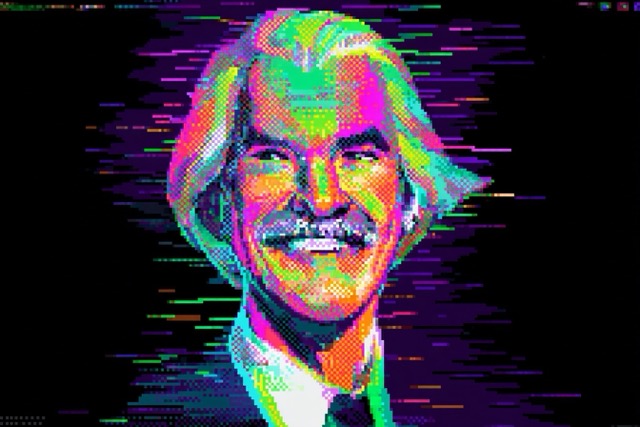
How does a respected Harvard psychologist, seen by his peers as a "promising scholar," become, in the words of President Richard Nixon, "the most dangerous man in America"? The story of Timothy Leary is a whirlwind journey from the top of the academic world to the heart of the 1960s counterculture. It’s a saga marked by groundbreaking psychological research, fierce public controversy, a cinematic prison escape, and a complex legacy that continues to influence the world today.
From a Conventional Path to a Psychedelic Awakening
Before he was a household name, Timothy Leary led a conventional academic life. After earning a Ph.D. in psychology from the University of California, Berkeley in 1950, he spent the decade building a solid reputation. He was known for developing new group therapy techniques and publishing an influential system for classifying human behavior. By 1959, his work earned him a coveted lecturer position at Harvard University, where his interests began to shift toward the power of consciousness.
Everything changed during a vacation to Mexico in the summer of 1960. There, a 39-year-old Leary reluctantly consumed psilocybin mushrooms for the first time. The experience was a profound revelation. He later famously claimed that in those five hours, he learned "more about [his] brain and its possibilities… and more about psychology" than he had in his entire 15 years of formal research. This single event turned his life upside down, igniting a mission to explore these substances not as a side interest, but as the very key to understanding the human mind.
The Harvard Psilocybin Project: Science Meets Controversy
Returning to Harvard with a new sense of purpose, Leary and his colleague, Richard Alpert (who would later be known as Ram Dass), co-founded the Harvard Psilocybin Project in 1960. Their goal was to scientifically study how psychedelic substances could expand human consciousness. They invited not only graduate students but also poets, artists, and musicians—from Allen Ginsberg to the jazz legend Thelonious Monk—believing that creative minds could best illuminate the drug's effects. One early participant even called the experience a "psychic godsend."
Through these sessions, Leary popularized the now-essential concept of "set and setting"—the idea that a person's mindset (the "set") and their physical and social environment (the "setting") are the most crucial factors in shaping a psychedelic experience. With a positive mindset in a supportive environment, Leary reported, the experience was far more likely to be beneficial.
However, their methods soon became highly unusual for the time. Leary and Alpert began taking psychedelics alongside their research subjects, blurring the strict lines between researcher and participant. In one famous study, the Concord Prison Experiment, Leary gave psilocybin to prison inmates to see if the experience could reduce the likelihood of them reoffending after release. These unorthodox approaches alarmed Harvard's administration, who worried about the ethics of professors giving mind-altering drugs to students and convicts.
The breaking point came in the spring of 1963, when the university discovered that Richard Alpert had given psilocybin to an undergraduate student, directly violating an agreement to only work with graduate students. The ensuing scandal was explosive. Harvard fired both Leary and Alpert, an event that thrust the topic of psychedelics into mainstream headlines for the first time.
Read More About The Harvard Psilocybin Project
High Priest of the Counterculture
Freed from the limits of academia, Leary fully embraced his role as a public champion for the psychedelic movement. He and a group of followers relocated to a sprawling estate in Millbrook, New York, financed by heirs to the Mellon family fortune. The mansion became a legendary hub for LSD sessions, spiritual exploration, and a lifestyle dedicated to breaking free from conventional society. Along with Alpert and Ralph Metzner, he published The Psychedelic Experience (1964), a guidebook for navigating an LSD trip that was modeled on the Tibetan Book of the Dead.
His influence peaked during the 1967 "Summer of Love." Standing before a massive gathering of hippies in San Francisco, Leary delivered his iconic and unforgettable slogan: "Turn on, tune in, drop out." He urged the nation's youth to "turn on" with LSD, "tune in" to a higher consciousness, and "drop out" of the mainstream social and political structures. Delighting in the media attention, he cheekily told reporters, "To learn how to use your head, you have to go out of your mind." The press crowned him the "High Priest of LSD," a role he played with dramatic style as he toured the country.
Public Enemy Number One and a Daring Escape
Leary's showy support made him a primary target for a government and public gripped by a moral panic. Newspapers ran alarming and often exaggerated headlines about LSD-induced tragedies, such as students going blind after staring at the sun or leaping from windows. In response, the law moved swiftly. California banned LSD in 1966, and by 1970, the federal Controlled Substances Act classified psychedelics as Schedule I drugs, a category for substances with "no legitimate medical use."
Leary personally felt the full force of this backlash. After several arrests, he was handed an extremely harsh 30-year prison sentence for the possession of just two marijuana cigarettes found in his daughter's luggage.
But his story was far from over. Ever the psychologist, Leary cleverly gamed a prison personality test—one he had ironically helped design years before—to portray himself as a calm, low-risk prisoner. The trick worked, and he was transferred to a minimum-security prison. In September 1970, he made a daring escape, shimmying along a 100-foot telephone wire over a barbed-wire fence to freedom. The escape was arranged by the radical leftist group, the Weather Underground, and he was whisked away by emissaries of the Brotherhood of Eternal Love, a hippie group known for smuggling LSD.
For the next few years, Leary was an international fugitive, with President Nixon personally focused on his recapture. He hid in Algeria with exiled Black Panther leader Eldridge Cleaver and later sought refuge in Switzerland. His run finally ended in 1973 when U.S. agents apprehended him in Afghanistan. After his return, he spent several more years in prison, including a stint in solitary confinement at Folsom Prison, just down the hall from cult leader Charles Manson.
Final Act: From Counterculture to Cyberculture
After his final release from prison in 1976, Leary reinvented himself once again. In one of his life's strangest twists, he began touring the college debate circuit with G. Gordon Liddy, the very Watergate conspirator and former lawman who had once arrested him. He also became an early and enthusiastic supporter of personal computers, video games, and the internet, famously declaring that "the PC is the LSD of the 1990s." He saw digital technology as the next great frontier for expanding consciousness. He even developed a philosophy he called "SMILE"—an acronym for Space Migration, Increased Intelligence, and Life Extension—urging humanity to colonize space.
When diagnosed with terminal cancer, Leary faced death with his usual dramatic style, chronicling his final days on his website for the world to see. After he died in 1996, a portion of his ashes was launched into outer space, a fitting final journey for a man who always urged people to go beyond their limits.
A Complex and Controversial Legacy
Timothy Leary remains a deeply divisive figure. On one hand, he was a pioneer.
-
While other thinkers of his time, like Aldous Huxley, argued that psychedelics should be reserved for a small intellectual elite, Leary was a populist.
-
He passionately believed that everyone should have the right to explore their own consciousness.
-
He introduced millions of Americans to the very idea of altered states.
Yet, many historians and scientists argue that his dramatic and shocking style did serious, long-term damage.
- His call for everyone to "turn on" fueled the moral panic that ultimately led to the criminalization of psychedelics, shutting down nearly all promising scientific research for decades.
Today, in the midst of a modern "psychedelic renaissance," Leary's legacy is being re-examined.
-
Many modern researchers pointedly distance themselves from his methods, focusing instead on careful, clinical science to avoid repeating the backlash of the 1960s.
-
A recent major Netflix documentary on psychedelics, for instance, mentions Leary only briefly, almost as an afterthought. Yet, without his bold and controversial crusade, it's unlikely the conversation around these substances would be where it is today.
His life remains both an inspiration and a powerful cautionary tale.