
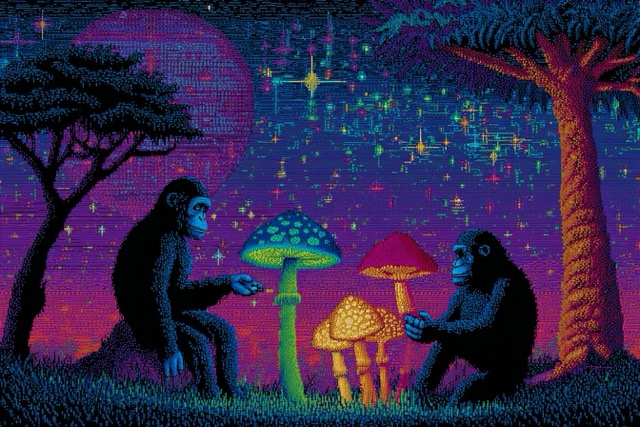
At the heart of one of modern science's most captivating and controversial ideas is a simple question: What if psychedelic mushrooms are the reason we're human? This is the essence of the Stoned Ape Theory, a hypothesis suggesting that our ancient ancestors’ encounter with psilocybin mushrooms triggered a rapid and profound evolution of the human mind. It's a narrative that bridges the gap between science and mysticism, asking us to consider how altered states of consciousness may have forged our very being.
The Theory’s Visionary Origins
- The Stoned Ape Theory was first detailed by American ethnobotanist and mystic Terence McKenna in his 1992 book Food of the Gods.
- McKenna proposed that during the Late Pleistocene, when anatomically modern humans had emerged (around 300,000 years ago) and symbolic culture was developing (50–70,000 years ago), a leap in cognition was sparked by the addition of psilocybin-containing mushrooms to the human diet.
- He pictured our ancestors moving from shrinking forests onto grasslands in Africa, following herds of cattle and discovering psychoactive fungi growing in their dung. This chance encounter, he argued, was the “evolutionary catalyst” for the human mind.
- The nickname “Stoned Ape Theory” came later as a tongue-in-cheek label. Terence’s brother and collaborator, Dennis McKenna, has said the name trivializes what was meant as a serious attempt to explain how the human brain tripled in size over 2 million years, sparking creativity, language, and self-awareness.
How Mushrooms Could Have Made Us Human
McKenna speculated on a layered scenario in which psilocybin might have offered survival and cultural advantages:
- Sharpened Senses: He suggested that small doses could have sharpened visual perception, improving edge detection for hunting and survival.
- Increased Reproduction: McKenna imagined that moderate doses might have acted like an aphrodisiac, boosting libido and energy, and potentially leading to more frequent mating and greater genetic diversity.
- Community and Ritual: At higher, psychedelic doses, he believed mushrooms might have dissolved ego boundaries and sparked early religious or mystical experiences. McKenna envisioned group rituals or trance-like states that strengthened bonds and deepened social cohesion.
- Language and Art: His boldest idea was that psilocybin experiences could have jump-started symbolic thought. He speculated that visions and cross-sensory experiences (like “seeing sounds” or “hearing colors”) pushed the brain to invent new symbols, eventually giving rise to language, art, and spiritual imagination.
The Scientific Backlash
When first proposed, the Stoned Ape Theory was met with skepticism:
- Lack of Evidence: No direct archaeological or fossil proof of psilocybin consumption exists, since fungi leave no trace over millennia.
- The Inheritance Problem: Psychedelic experiences don’t alter DNA and thus can’t be inherited. Lamarckian evolution is discredited.
- Other Theories: The Social Brain Hypothesis links intelligence to complex group living; the Expensive-Tissue Hypothesis ties it to higher-calorie diets.
- Pseudoscience Concerns: Many scientists dismiss the theory as narrative-driven speculation lacking testable data.
What Evidence Would Scientists Need?
Researchers would look for:
- Traces of psychedelic plant or fungi use at prehistoric sites.
- Genetic evidence of serotonin-related adaptations.
- Cross-cultural links between mushroom use and symbolic culture.
- Evolutionary models showing survival advantages from psychedelic-driven behaviors.
The Spiritual Allure and Modern Renaissance
Despite doubts, the theory resonates spiritually:
- It offers a mythic story of awakening, echoing traditions that see plants as teachers opening the “doors of perception.”
- Mycologist Paul Stamets argues psilocybin may have fostered courage and empathy, aiding survival.
- Recent psychedelic research shows psilocybin promotes neuroplasticity, boosts creativity, and induces mystical states with lasting effects.
- A 2024 multidisciplinary review concluded mushrooms “may have contributed” to consciousness development by enhancing memory, introspection, and social cohesion.
- Thinkers like Bobby Azarian suggest mushrooms sparked rapid cultural evolution, spreading behaviors and ideas “virally” in prehistoric communities.
A Catalyst for Thought
The Stoned Ape Theory remains speculative, but it endures as a thought experiment at the crossroads of science, spirituality, and philosophy. While most experts doubt mushrooms alone "made mankind," the hypothesis reminds us of humanity’s deep and ancient relationship with mind-altering plants, one that continues to shape our understanding of consciousness today.
Sources
The Stoned Ape Theory Revisited - Psychology Today
A New Spin on the Stoned Ape Hypothesis - Big Think
The Stoned Ape Theory - Fantastic Fungi
No, Human Consciousness is Not a Result of Magic Mushrooms - Psychology Today
Terence McKenna Might Have Been Right - DoubleBlind